I’ve noticed a pattern in the founders who find their way to Cadre: by the time we speak, they’re often worn down by recruiting.
They’ve spent evenings scouring LinkedIn, rewriting pitches, following up, and squeezing in candidate calls. They’ve tried AI sourcing platforms promising the perfect match — only to discover that AI can also make candidates look better on paper than they are in practice. Polished résumés, inflated abilities, sometimes outright fake profiles. Someone still has to verify what’s real.
Sure, they’ve learned a lot. But the role is still open, and recruiting has quietly become an arduous second job.
I understand why they start there. At the seed stage, every dollar matters, and hiring for a small eng team is too important to hand off. The harder calculation is what those hours are costing the company — especially when weeks of effort may produce one hire, or none.
The battle scars are worth getting
There is a good reason for a seed-stage founder to spend time sourcing candidates personally: you learn things that a job description cannot teach you.
The engineer you thought would love the opportunity wants more cash and less equity. That strong backend engineer at Stripe who is mildly excited about what you’re building has no interest in working onsite. That mid-level full-stacker asks who will mentor them, and you realize your pitch about “ownership” sounds different to a person who would be one of the founding engineers.
Those conversations are valuable, and so are the rejections. They force you to confront whether the engineer you want exists at the intersection of your comp, onsite requirement, technical skill set, and company stage. They also reveal whether your pitch gives that person a compelling reason to leave a job they are perfectly content with.
I believe a founder should get some recruiting battle scars under their belt. That experience makes you a better leader and ultimately a more credible person for candidates to speak with.
But after you have heard the same objections repeatedly, there is a question worth asking: what are you learning from the next ten hours of sourcing that you did not learn from the last ten?
At some point, you understand the market. You have adjusted the role. You know which compromises you can make. And you are still spending your evenings opening profiles and following up with people who have never replied. That is where the unit economics deserve a closer look.
What the funnel actually looks like
We recently reviewed our own LinkedIn Recruiter analytics for August — just one of the sources we use to find passive engineering talent. We sent 1,046 InMails, including follow-ups, and recorded 116 responses — an 11.1% response rate. Ninety-nine were acceptances, seventeen were declines, and 930 got no response at all. The acceptances were openings for further conversation; they did not establish that anyone got on the phone with us, met the requirements of one of our clients, or wanted to pursue any opportunity at all.
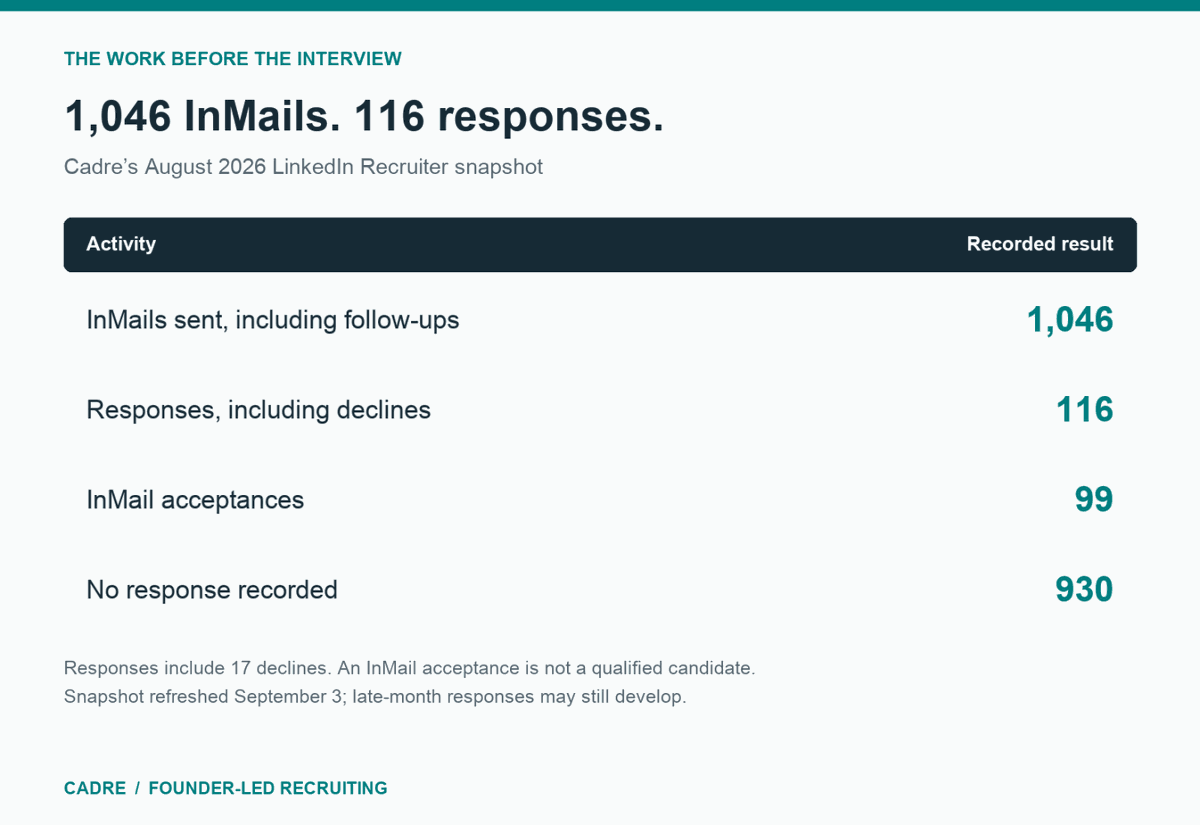
These figures also begin after the profile scouring and countless adjustments to our search strings. They do not capture the 10x more profiles that were reviewed and passed over before a message was ever sent. This is one small agency’s reporting snapshot, with some late-month responses still developing — a founder’s results could differ substantially. But it illustrates how much activity can precede even the possibility of an interview. And an interview is still several steps away from a hire.
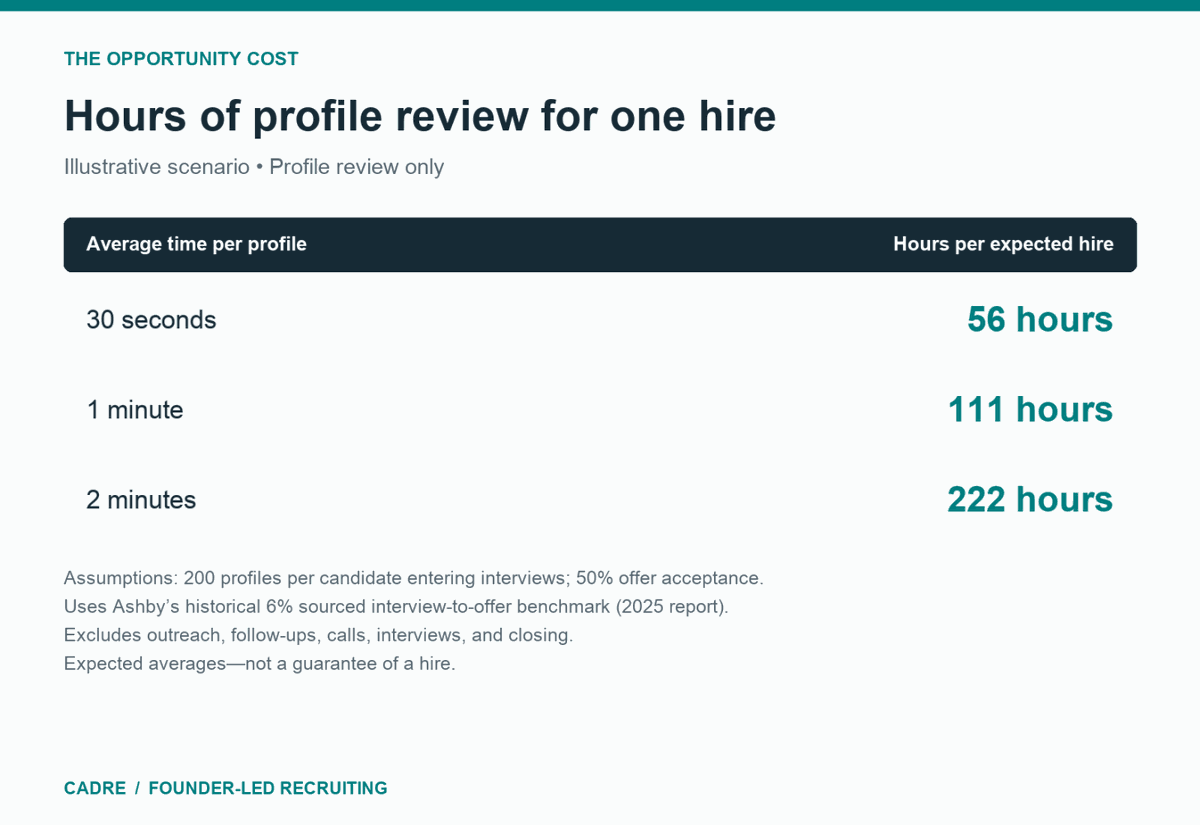
Ashby’s 2025 analysis of more than 38 million applications across 93,000 jobs reported that 6% of interviewed, sourced candidates progressed to an offer. That is a broad historical benchmark covering 2021–2024, not a prediction for every seed-stage startup — but it’s a useful reference point for a planning exercise. For this exercise, suppose your company closes 50% of its offers.
The math works backward. One accepted offer requires two offers, on average. At a 6% interview-to-offer conversion, two offers require roughly 33 candidates entering interviews. If each candidate entering interviews requires reviewing 200 profiles — an estimate for this exercise, not a measured Cadre conversion rate — that means approximately 6,667 profile reviews per hire, counting the profiles rejected before outreach and the outreach that never becomes an interview.
At one minute per profile: 200 ÷ (6% × 50%) ÷ 60 ≈ 111 hours of profile review per accepted offer. That is almost three 40-hour working weeks — and it excludes writing customized messages, following up, managing replies, scheduling, screening calls, interviews, references, and closing the candidate.
The assumptions move the number, but not the conclusion. At thirty seconds per profile it’s roughly 56 hours; at two minutes, roughly 222. Improve interview-to-offer conversion to 10% and profile review falls to about 67 hours per hire; at 5%, it rises to about 133. The numbers are averages for planning — reviewing 6,667 profiles does not guarantee a hire.
The opportunity cost
Even the middle scenario is substantial. At two hours of profile review each weekday, 111 hours represents roughly 11 weeks of that daily commitment — before the additional recruiting work. A seed-stage startup can be disciplined about spending cash while being remarkably casual about spending founder attention. Recruiting help comes with an invoice. Doing it yourself comes with a calendar full of work that can be harder to price.
This does not mean founders should stop sourcing altogether. A personal message to a particularly important candidate may be an excellent use of time. So may working through your network, testing a revised pitch, or joining an early conversation to understand why the opportunity is missing the mark. Founders also need to act on what they learn — an unrealistic comp/equity range or an incoherent role will remain a problem after a recruiter takes over.
The useful transition comes when the founder can explain exactly who they need, why that person would join, and which tradeoffs the startup can make. From there, someone else can take responsibility for the sustained research, outreach, follow-up, and qualification required to keep the top of funnel going.
That is the case for a recruiting partner like Cadre: turning a large volume of sourcing work into a consistent flow of relevant, interested, and ultimately viable candidates the leadership can spend time with. A partner should earn that investment through candidate quality, progress toward hires, and founder time recovered. The founder still owns the hiring bar — and has an essential role in selling the opportunity.
Get the battle scars. Learn what the market is telling you. Fix the role and sharpen the pitch. Then look at the hours required to produce your next hire — and decide whether personally doing all of that work is still the best use of your time.